Other Prices
| Product / Item | Brand | Variant / Model | Unit | Price |
|---|---|---|---|---|
| Rinnai Gas Heater RHS1260 | Rinnai | RHS1260 | unit | Rs. 98,900 |
Japanese Gas Room Heaters
| Product / Item | Brand | Variant / Model | Seller / Market | Unit | Price |
|---|---|---|---|---|---|
| 2.4 kW Oval-Panel Imported Gas Room Heater | Rinnai | 2.4 kW oval panel | Comfort Solutions | one unit | Rs. 17,000 |
| 2.4 kW Flat-Panel Japanese Gas Blower Heater | Rinnai | 2.4 kW flat panel | Bara Market | one unit | Rs. 17,999 |
| 2.4 kW Japanese Gas Blower Heater Imported | Rinnai | 2.4 kW | Imported Bazar | one unit | Rs. 25,500 |
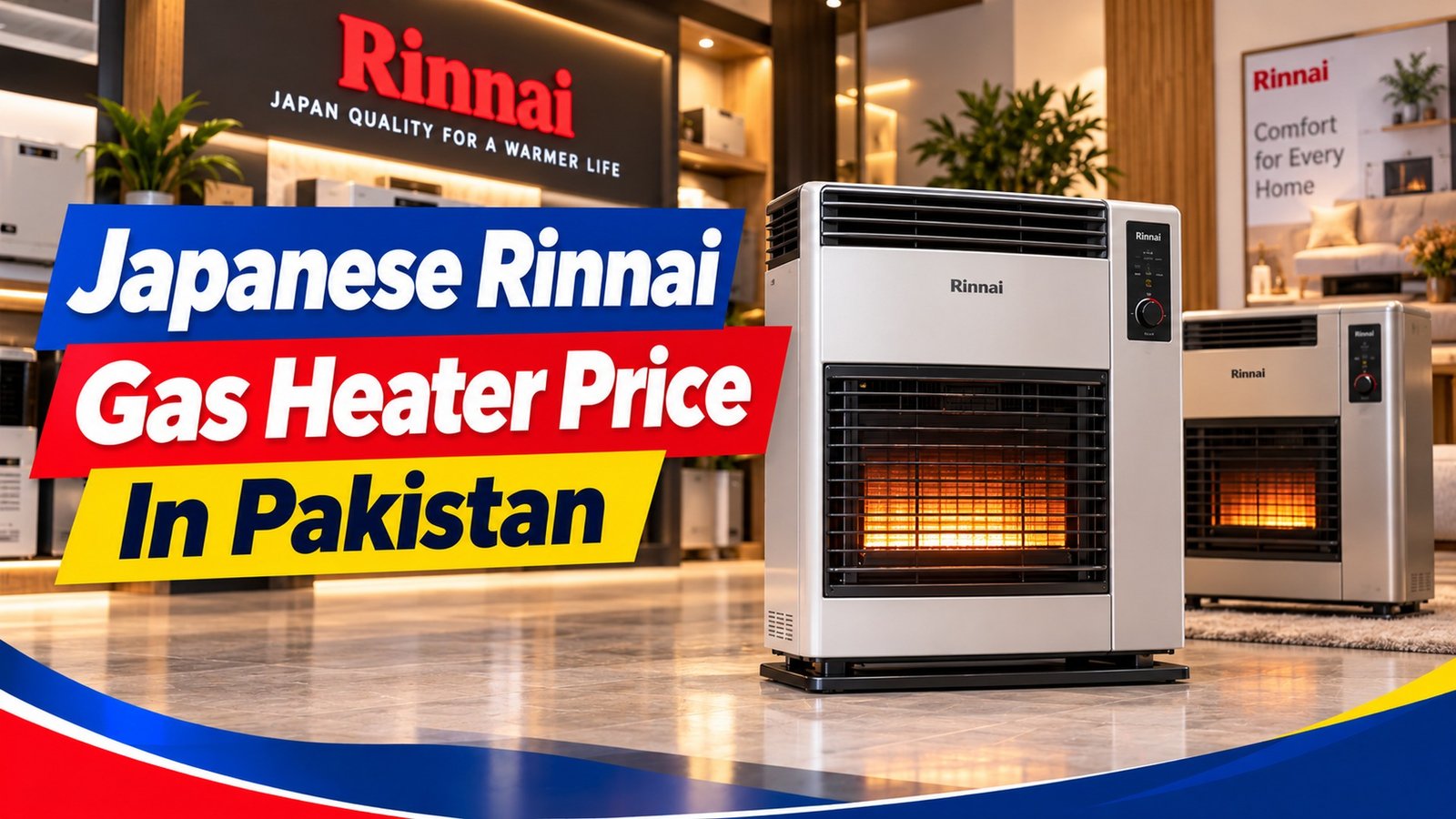
Japanese Rinnai gas heater prices in Pakistan depend on the exact model, fuel specification, condition and seller, not simply the Rinnai name. These appliances heat room air; they must not be confused with Rinnai gas geysers that heat water. Rinnai Japan lists fan-heater models including RC-U5801PE and RC-Y4002PE, with differing heating outputs and room-size guidance. Some Japanese domestic versions are marked AC 100 V, which is not directly interchangeable with Pakistan’s typical 220–240 V household supply. Imported or second-hand stock also needs a documented gas-type match, working safety controls and a safe installation assessment. Any Pakistani asking price should be associated with the photographed nameplate and actual delivered condition, rather than borrowed from a different Japanese model.
What the Japanese Rinnai label actually tells you
Rinnai is a Japanese appliance maker, but brand origin does not prove the provenance of a particular heater. A machine sold as Japanese may be a domestic-market fan heater, an older imported appliance or a product sourced through another regional market. The model code is more reliable than a seller’s shorthand. Ask for an unobstructed picture of the serial and rating label, followed by a clear demonstration performed under appropriate professional conditions.
The company’s Japanese fan-heater range distinguishes Standard, A-style and Wiz families. These are not interchangeable models with one universal output or electrical requirement. For example, the official Standard specification identifies the RC-U5801PE at 5.81 kW heating capacity and gives separate guidance for wood and concrete room construction. That Japanese room guidance is not an automatic coverage guarantee for Pakistani homes with different insulation, ceiling height or ventilation requirements.
How to compare models without trusting vague advertisements
A buyer may find Rinnai model strings attached to photographs that do not match the machine being offered. Compare the front-control layout, gas-connection arrangement and original rating plate with the correct manufacturer documentation. For the Japanese Standard range, the RC-U5801PE is a larger output model, whereas RC-Y4002PE and RC-Y2402PE appear as separate smaller Standard variants. Never assume a feature described for one model is present on another.
The product’s age matters for reasons beyond cosmetic wear. Fan motor noise, damaged switches, loose gas fittings and altered wiring can make a previously owned heater unsuitable even if it produces heat during a short demonstration. Treat any seller claim that a second-hand unit has been ‘converted for Pakistan’ as a request for documentary proof from a qualified technician, not as reassurance that a physical alteration is safe.
To see how this imported model fits among locally discussed room-warming equipment, consult the heater price overview.
Gas compatibility comes before price
The first technical question is whether the unit is configured for natural gas or LPG, including the manufacturer’s required pressure and connection standard. Two appliances with similar appearance may need different jets or regulated input pressures. Substituting cylinder gas for mains gas without a manufacturer-approved conversion can create unsafe combustion. Do not improvise nozzles, hoses or adapters to make an imported heater fit an existing supply.
Availability of piped gas varies by location and season in Pakistan. If the property uses cylinders, ask a licensed gas professional whether the specific heater is approved for that fuel and installation. If the original manual cannot be found and the data plate is missing, there may be no reliable way to establish compatibility. A lower purchase price is not useful if safe operation cannot be verified.
| Model | Official Japanese family | Verified distinction |
|---|---|---|
| RC-U5801PE | Standard | 5.81 kW heat output; 100 V electrical supply |
| RC-Y4002PE | Standard | Different smaller-capacity Standard variant |
| RC-Y2402PE | Standard | Separate compact Standard model |
| RC-A4401NP | A-style | Manufacturer lists remote-control capability |
Electrical rating: the easy-to-miss Japanese import issue
Some Rinnai Japanese fan heaters rely on mains electricity for fan circulation and electronic control even though gas supplies the heat. Official Japanese Standard-model information lists AC 100 V, 50/60 Hz for the RC-U5801PE. Connecting a 100-volt appliance directly to a Pakistani 230-volt circuit risks equipment failure and fire; the exact plate specification must govern any electrical plan.
A suitable electrical arrangement, if professionally feasible, is an additional part of ownership cost. A converter’s rating, isolation, grounding and suitability for a continuous appliance load need assessment by a qualified electrician. An inexpensive travel plug does not reduce voltage. A heater described as ‘gas only’ should still be checked for a power cord and electrical controls before money changes hands.
An electrical alternative has different risks and running costs; compare the electric room heater guide before selecting a heating system.
Ventilation, carbon monoxide and household use
Combustion appliances can produce carbon monoxide (CO) when poorly maintained, incorrectly fueled or inadequately ventilated. Rinnai Japan specifically describes ventilation reminders and incomplete-combustion safeguards on certain fan-heater products, but those features never replace correct ventilation. Follow the exact model manual and local professional installation advice; a generic social-media demonstration is not an operating guide.
Never use a malfunctioning gas heater in a sleeping space or make a sealed room ‘more efficient’ by blocking ventilation. Fit appropriate CO alarms according to their instructions, keep combustible items away from hot surfaces, and stop using the appliance if an alarm sounds, someone becomes unwell, or combustion appears abnormal. Leave the area and obtain emergency assistance rather than repeatedly attempting ignition.
Inspection checklist before paying
- Photograph the exact model plate and verify fuel and electrical ratings.
- Ask whether the unit is new, refurbished or used; obtain a condition description in writing.
- Have a qualified installer evaluate approved gas connections and ventilation.
- Confirm functional safety controls and avoid unknown or modified appliances.
- Compare the invoice total, including compatible accessories and delivery.
What the total Pakistani buying bill can contain
A quote for a Japanese imported heater might cover only the appliance. Ask whether the stated figure includes a tested gas connection, electrical compatibility assessment, approved accessories, delivery and any written service commitment. A 100-volt appliance requiring additional equipment cannot be compared fairly with a locally specified model solely by sticker price. For a used item, account for the possibility that spare parts are unavailable in the local market.
Pakistani price claims also need a date and seller identity. A rate reported for Karachi cannot be safely re-labelled as Lahore or Islamabad without a separate observation. Compare one model and condition at a time, and ask the seller to put the full model number on the invoice. Imported-new, old-new-stock and used units should not share a single undifferentiated price.
A heater intended for hot water is an entirely different appliance, as explained in the household geyser guide.
Choosing room heating rather than water heating
A gas room heater and a gas water heater perform entirely different jobs. A room heater warms indoor air; a geyser heats water for taps or other approved fixtures. The two products may carry the same brand, yet their fittings, ventilation methods and sizing criteria differ. If the search started from a need for hot bathing water, buying a room heater would not solve it.
For room warmth, compare Rinnai’s actual heat output, ventilation requirements, local fuel availability and service options with alternative heating technologies. Electric heaters avoid on-site gas combustion but bring their own electricity-demand and wiring considerations. Choose the heating method after checking the room and supply, not from the brand image alone.
Questions buyers ask
Are Japanese Rinnai gas heaters available officially in Pakistan?
Rinnai’s Japanese website verifies product families, but that does not prove official Pakistan distribution for a specific Japanese fan-heater model. Ask the seller for import documentation, a model-matched manual and local warranty details. Without a confirmed local distributor or stocked listing, treat availability as seller-specific rather than nationwide. Used-import market advertisements should be separated from manufacturer-backed stock.
Can a 100 V Japanese Rinnai heater run on 220–240 V?
Not directly. A model rated AC 100 V must not be connected to Pakistan’s common 220–240 V socket. A qualified electrician should assess whether a suitable power arrangement is possible and safe for the exact device. A plug-shape adapter is not a transformer. If the rating plate is damaged or unreadable, do not guess the input requirement.
Will an LPG cylinder work with a natural-gas Rinnai heater?
Do not assume it will. Natural gas and LPG have different supply characteristics, and a heater has to be explicitly approved and configured for the chosen fuel. A technician should inspect the nameplate, manual, regulator and connections. Improvised fuel conversion is unsafe, even if the burner briefly lights during testing.
Is a used Rinnai heater worth buying?
Only if its model, condition, fuel compatibility, safety systems and serviceability can all be checked. Request photographs, a detailed written invoice and a professional functional inspection. A cheap appliance that needs unavailable parts or a questionable electrical conversion may be costly to own. Avoid devices with modified gas plumbing, unstable flames, damaged wiring or missing identification.
Which Rinnai model is best for a large room?
No model can be recommended from room area alone. The Japanese RC-U5801PE has a manufacturer-listed 5.81 kW heating capacity, but local heat loss, ventilation, gas supply and the manufacturer’s intended installation all matter. Have a qualified professional assess room conditions and the exact imported product before choosing capacity. Do not apply Japanese tatami-room guidance as a universal Pakistan sizing rule.
Does a Rinnai gas heater need ventilation?
Yes. Follow the ventilation requirements in the model-specific manual and the qualified installer’s assessment. Some modern Rinnai fan heaters provide ventilation reminders or combustion safeguards, but those are backups rather than permission to seal the room. CO is not reliably detected by smell. Use suitable detectors and leave the area if an alarm activates or occupants develop concerning symptoms.
Why do quoted Rinnai heater prices differ between sellers?
Quotes may refer to different models, import histories, condition grades or included accessories. One seller may include a compatible connector and written warranty while another offers an untested heater only. Compare the same complete model code and operating condition, and record the seller and date of each figure. A foreign suggested retail price is not a verified Pakistan transaction price.
Manufacturer and safety references
Model specifications are attributed to the original manufacturers. The safety references are institutional guidance; local installation must follow the applicable appliance manual and regulations. Product availability, stored price data and shop quotations should be checked independently.
- Rinnai Japan Standard heater specifications
- Rinnai Japan gas fan-heater family
- CDC carbon monoxide safety guidance