Punjab Prices
| Product / Item | Variant / Model | City / Region | Unit | Price |
|---|---|---|---|---|
| Steel rebar | Grade 40 | Lahore | per kg | Rs. 244 – Rs. 248 |
| Steel rebar | Grade 60 | Lahore | per kg | Rs. 250 – Rs. 252 |
| Steel rebar | Grade 40 | Rawalpindi | per kg | Rs. 245 – Rs. 249 |
| Steel rebar | Grade 60 | Rawalpindi | per kg | Rs. 251 – Rs. 253 |
| Steel rebar | Grade 40 | Faisalabad | per kg | Rs. 243 – Rs. 247 |
| Steel rebar | Grade 60 | Faisalabad | per kg | Rs. 249 – Rs. 251 |
| Steel rebar | Grade 40 | Multan | per kg | Rs. 243 – Rs. 247 |
| Steel rebar | Grade 60 | Multan | per kg | Rs. 249 – Rs. 251 |
Sindh Prices
| Product / Item | Variant / Model | City / Region | Unit | Price |
|---|---|---|---|---|
| Steel rebar | Grade 40 | Karachi | per kg | Rs. 246 – Rs. 250 |
| Steel rebar | Grade 60 | Karachi | per kg | Rs. 252 – Rs. 254 |
Khyber Pakhtunkhwa Prices
| Product / Item | Variant / Model | City / Region | Unit | Price |
|---|---|---|---|---|
| Steel rebar | Grade 40 | Peshawar | per kg | Rs. 244 – Rs. 248 |
| Steel rebar | Grade 60 | Peshawar | per kg | Rs. 250 – Rs. 252 |
Balochistan Prices
| Product / Item | Variant / Model | City / Region | Unit | Price |
|---|---|---|---|---|
| Steel rebar | Grade 40 | Quetta | per kg | Rs. 245 – Rs. 249 |
| Steel rebar | Grade 60 | Quetta | per kg | Rs. 251 – Rs. 253 |
Islamabad Capital Territory Prices
| Product / Item | Variant / Model | City / Region | Unit | Price |
|---|---|---|---|---|
| Steel rebar | Grade 40 | Islamabad | per kg | Rs. 245 – Rs. 249 |
| Steel rebar | Grade 60 | Islamabad | per kg | Rs. 251 – Rs. 253 |
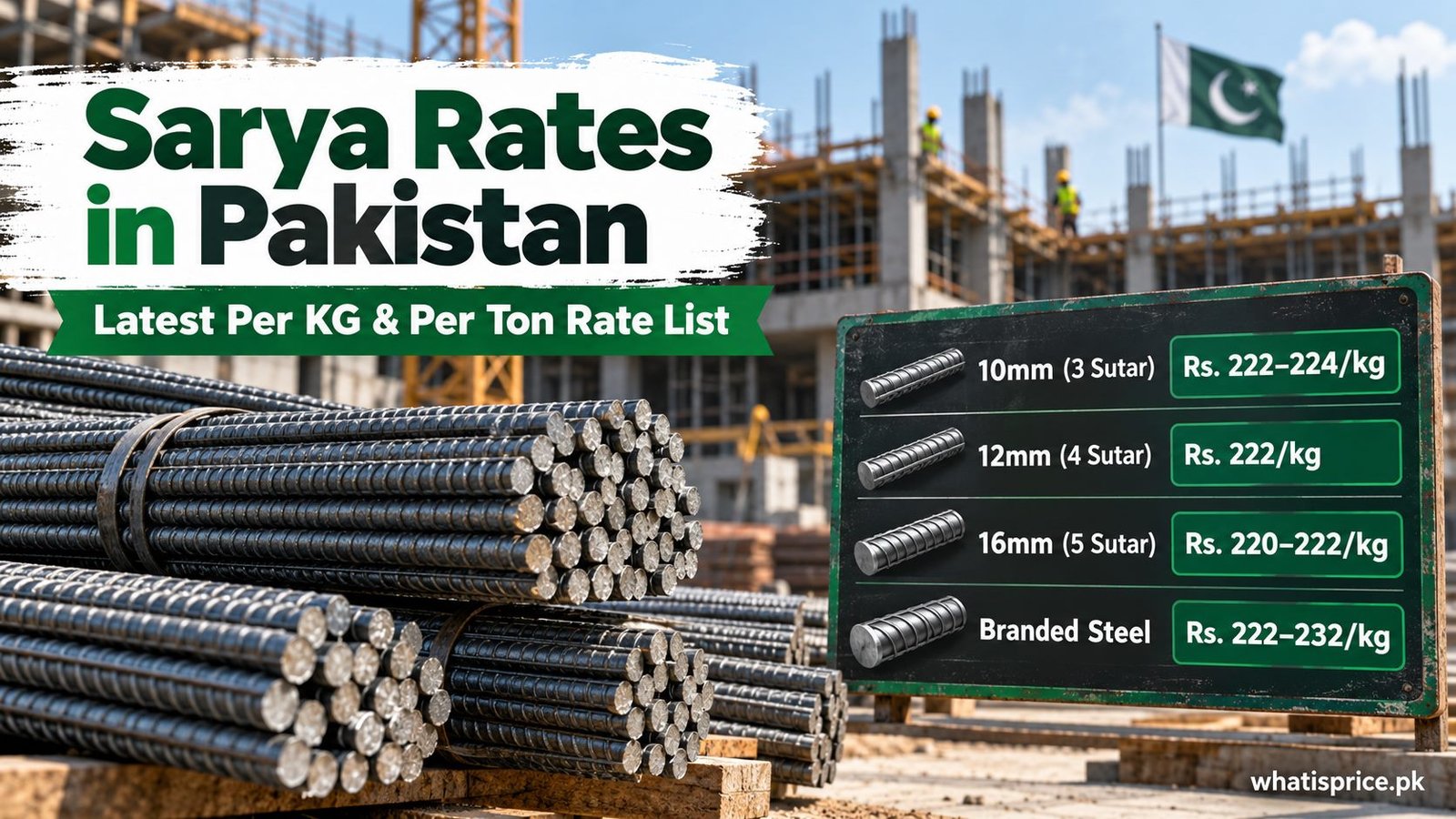
The sarya rate in Pakistan is generally quoted per kilogram or per metric tonne. A useful quotation specifies steel grade, bar diameter, mill or manufacturer, city, date and whether delivery is included. Do not compare two prices unless those details match. The price listings above provide market context, but the final site-delivered cost must be confirmed with the supplier.
Grade 40 versus Grade 60 sarya
Grade labels describe minimum strength categories used in steel-bar specifications. Grade 60 and Grade 40 are not interchangeable simply because one happens to be on offer at a lower rate. Pakistan Standards and Quality Control Authority lists standards covering reinforcing steel; manufacturers commonly refer to ASTM and local PS specifications on product documentation.
| Feature | Grade 40 | Grade 60 |
|---|---|---|
| Nominal minimum yield strength under corresponding ASTM-style grade designation | 40,000 psi | 60,000 psi |
| Selection basis | Engineering drawings and specifications | Engineering drawings and specifications |
| Buying verification | Mill certificate, grade marking, declared standard | Mill certificate, grade marking, declared standard |
| Can be substituted on price grounds? | No | No |
The strength descriptions above explain commonly used grade terminology; an actual shipment must meet the specific standard written into the project’s drawings. Only the responsible engineer should approve changes to reinforcement grade or bar diameter.
How steel rod sizes affect the purchase
In Pakistan, builders often use terms such as 3 sutar or 4 sutar alongside nominal metric diameters. Informal sutar labels are not a substitute for checking the actual diameter marked on the mill certificate or measured where appropriate. Ask the seller for the diameter in millimetres, bar length and total weight.
As a general engineering estimating rule for round steel rebar, mass per metre in kilograms is approximately diameter squared divided by 162, where diameter is in millimetres. This is a theoretical estimate rather than a substitute for weighbridge readings or applicable tolerances. For example, a 12 mm bar weighs approximately 12 × 12 ÷ 162 = 0.889 kg per metre. Multiply by the actual length to estimate a bar’s weight.
Converting a price per kg into a price per tonne
One metric tonne contains 1,000 kilograms. A quotation of Rs. 260 per kg therefore corresponds to Rs. 260,000 per metric tonne, before any additional transport or handling cost. The example is arithmetic, not a claim that Rs. 260 is the prevailing rate today. Always confirm the amount and whether prices include taxes before placing an order.
Material quantities should come from the structural bar-bending schedule or an approved bill of quantities. Buying steel solely from a rough house-area estimate can lead to shortages or unnecessary surplus.
Factory rates are not always dealer-delivered rates
Steel mills can publish their own Grade 40 and Grade 60 list prices. A mill quote may apply across regions while transport is charged separately. A dealer may charge more or less depending on brand, stock, lot size, credit terms and delivery distance. Therefore, a Lahore factory list and a Rawalpindi site delivery offer are not necessarily conflicting quotations; they may cover different services.
For the most defensible comparison, request itemized rates for the same grade, diameter, standard and quantity. Make the seller state whether loading, unloading and transport are included. If a dealer proposes an alternative mill, compare the actual documentation rather than relying on a claim that the rods are “equivalent”.
What to inspect when sarya arrives on site
Check manufacturer identification, heat or batch references where supplied, length and bar count, grade marking and the documents linking the shipment to the purchased specification. A mill test certificate may help verify mechanical properties, though its relevance must be checked against the bars delivered. Rust, excessive surface damage, unusual bending or missing traceability should be raised with the engineer or supplier.
Weighbridge documentation is especially valuable for bulk deliveries. It supports checking the total charged weight instead of relying only on a verbal count. For smaller purchases, ask how the shop computed weight per piece and whether theoretical or scale weight forms the invoice basis.
How to estimate a combined construction-material bill
Record rebar cost in kilograms or tonnes and cement cost in bags, then add the separate totals and freight. For example, 2 tonnes at an illustrative Rs. 260,000 per tonne would be Rs. 520,000 before delivery. This calculation says nothing about the correct steel quantity for a particular building.
Steel and cement are separate materials with different structural roles. For a complete materials comparison, also consult the existing cement price guide. Quantities, grades and applications must follow approved building specifications.
Questions about sarya rates
Is the per-tonne rate always exactly 1,000 times the per-kg rate?
Yes for the basic unit conversion when both prices cover the same material and terms. A delivery or loading charge can change the final invoice total.
Can Grade 40 bars replace Grade 60?
Never make that substitution solely to reduce cost. Check the structural plans and obtain formal approval from the responsible engineer.
What proves that a steel bar is the correct grade?
Review traceable manufacturer markings and test documents for the shipment against the required standard, with professional inspection as appropriate.