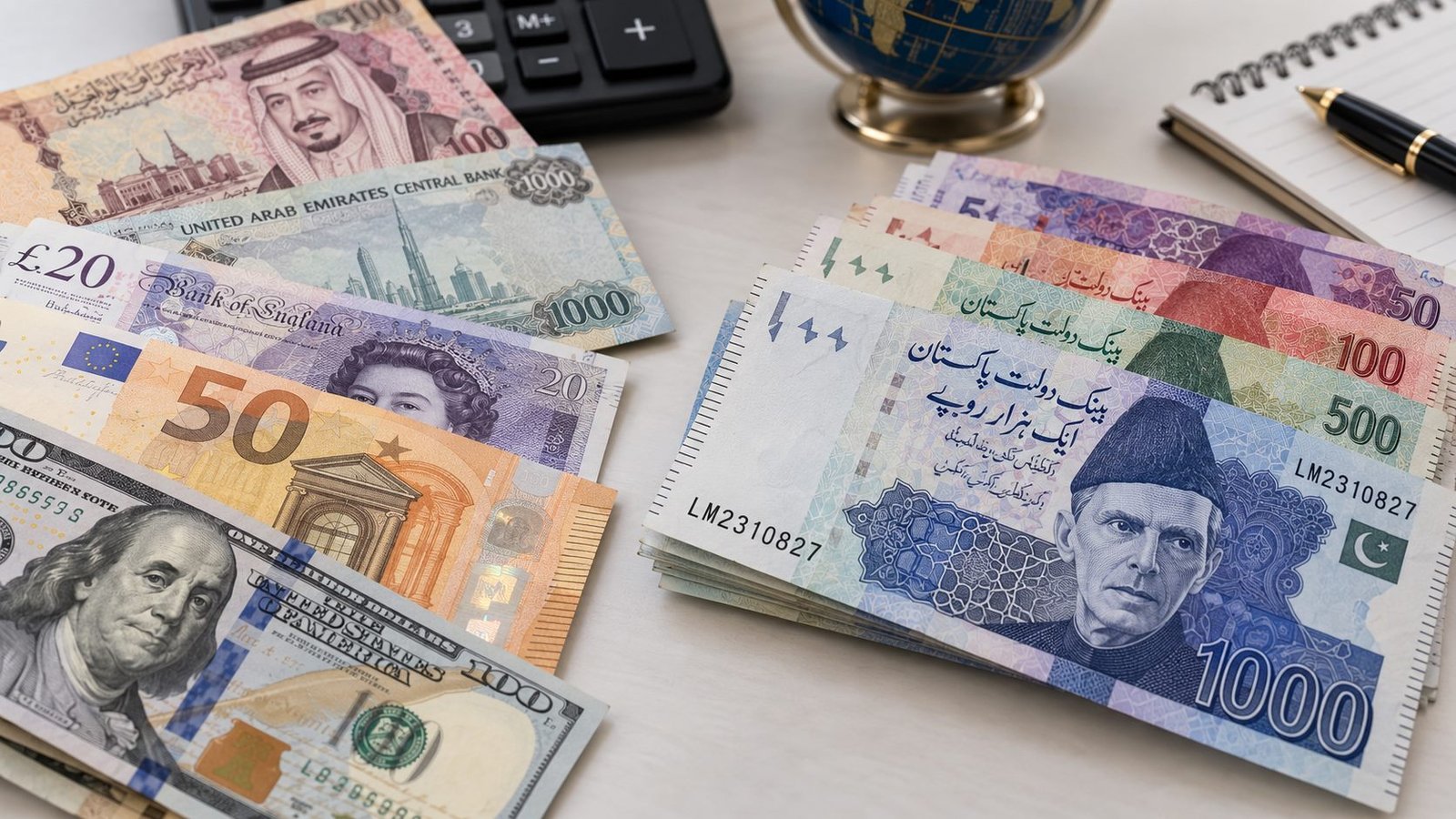
Currency Exchange Rates in Pakistan
Check the latest available US dollar, euro, pound, dirham and riyal rates in Pakistan. Compare open-market buying and selling prices, bank rates and PKR conversion values.
| Item | Buying (PKR) | Selling (PKR) | Published date | Change |
|---|---|---|---|---|
| UAE DirhamAED | 75.6500 | 76.1000 | 28 Oct 2026 | -0.07% |
| Australian DollarAUD | 195.5000 | 201.0000 | 28 Oct 2026 | +0.81% |
| Canadian DollarCAD | 196.0000 | 200.0000 | 28 Oct 2026 | -0.43% |
| EuroEUR | 308.5000 | 311.5000 | 28 Oct 2026 | -0.56% |
| British PoundGBP | 368.5000 | 371.5000 | 28 Oct 2026 | -0.40% |
| Japanese YenJPY | 1.7500 | 1.8000 | 28 Oct 2026 | No change |
| Saudi RiyalSAR | 74.0000 | 74.4000 | 28 Oct 2026 | -0.07% |
| US DollarUSD | 277.5000 | 277.8000 | 28 Oct 2026 | -0.01% |
| Item | Buying (PKR) | Selling (PKR) | Published date | Change |
|---|---|---|---|---|
| US DollarUSD | 276.4631 | 276.9199 | 28 Oct 2026 | -0.01% |
Currency Converter: Foreign Currency to PKR
The rate is for currency conversion only. Your bank or exchange dealer may offer a different price. Quote dates: 2026-10-27. Indicative, not an executable offer.
The converter uses reference exchange rates, which may differ from bank and open-market prices. Check the rate date before exchanging money.
Currency exchange rates in Pakistan show how many Pakistani rupees (PKR) are quoted for foreign currencies such as the US dollar (USD), Saudi riyal (SAR), UAE dirham (AED), euro (EUR) and British pound (GBP). The buying rate generally applies when a bank or exchange company buys foreign currency from you; the selling rate applies when it sells foreign currency to you. Rates can differ between the interbank market, exchange-company counters and money-transfer services. The table above supplies the available quotations, while the final amount depends on provider terms, fees and timing. Compare matching rate types rather than treating one published reference figure as a guaranteed cash rate.
How to read currency rates in Pakistan
Most Pakistan-facing foreign exchange tables quote PKR for one unit of foreign currency. A line marked USD/PKR therefore tells you how many rupees correspond to one US dollar at the displayed quotation. If you are converting dollars into rupees, you need to know whether the rate belongs to the institution buying your dollars. If you are purchasing dollars with rupees, you instead need its selling rate. Read the column heading before multiplying by a rate intended for a different transaction.
The date and time of the quote matter just as much as its numerical value. An end-of-day open-market figure, a morning bank reference rate and a live counter quotation describe different observations. Unless a widget explicitly states that it updates in real time, treat its values as dated information rather than a binding offer. Check the currency code, market type, units, update time and provider before using a rate for a payment decision.
Buying rate, selling rate, interbank rate and open-market rate
Pakistan’s State Bank describes the country’s exchange-rate regime as market-based and flexible, with rates shaped by foreign-currency demand and supply. Authorized dealers can quote their own buying and selling prices in the interbank market. The State Bank also publishes distinct exchange-rate datasets, including weighted-average customer rates, mark-to-market revaluation rates and open-market closing rates. These publications serve different purposes; they should not be presented as interchangeable promises to customers.
| Rate or quotation | What it represents | How to use it |
|---|---|---|
| Exchange-company buying rate | A provider’s quote for purchasing foreign currency from a customer | Compare when exchanging foreign banknotes into PKR |
| Exchange-company selling rate | A provider’s quote for selling foreign currency to a customer | Compare when purchasing travel cash with PKR |
| Bank customer quotation | A bank’s applicable quote for a particular customer transaction | Confirm the relevant cash, account or transfer product |
| Interbank market quotation | A rate relevant to transactions among authorized market participants | Use for market context, not as an automatic retail entitlement |
| SBP weighted-average customer rate | Published aggregate customer-rate information | Use as a reference alongside the correct observation date |
| SBP mark-to-market revaluation rate | A reference series principally used by authorized dealers for valuation | Do not treat as the cash counter’s selling price |
| Open-market closing rate | A reported open-market closing observation | Compare with similarly timed open-market quotes |
A provider’s spread is the difference between its selling and buying quotations for the same currency, market, time and unit. This is not necessarily the only cost of a transaction: remittance services, card issuers or banks may separately apply service charges, transfer fees or other adjustments. A narrower visible spread does not automatically mean a lower total cost if another charge applies.
Major foreign currencies followed in Pakistan
The currency families below help readers navigate the rate hub. A higher unit quotation does not prove that a currency is a better investment. The unit, direction of exchange and intended transaction are what matter. The shortcode above should provide the applicable figures for any currencies actually configured in the site’s rate dataset; the list below is a guide, not a claim that every currency has a verified current quotation.
| Currency | Code | Useful comparison context |
|---|---|---|
| US dollar | USD | Dollar purchases, overseas payments and dollar-to-rupee conversions |
| Saudi riyal | SAR | Saudi travel, household remittances and riyal cash exchange |
| UAE dirham | AED | UAE travel, salaries and dirham-to-rupee remittances |
| British pound | GBP | UK education, travel and bank transfers |
| Euro | EUR | Euro-area travel, study and import payments |
| Kuwaiti dinar | KWD | Kuwait-linked earnings and household conversions |
| Qatari riyal | QAR | Qatar-linked remittances and travel |
| Omani rial | OMR | Oman-linked remittances and travel |
| Canadian dollar | CAD | Canada-related education and travel payments |
| Australian dollar | AUD | Australia-related education and travel payments |
| Chinese yuan | CNY | China-related invoices and import comparisons |
| Japanese yen | JPY | Japan-related purchases and yen conversions |
US dollar (USD to PKR)
The dollar is an important reference for Pakistani readers comparing international payments and imports. For a dollar transaction, check both the source of the quotation and whether it applies to cash, a bank account or a remittance. A historical exchange chart answers a different question from a cash-selling quote available at a branch. For a narrower explanation of the pair, see the site’s USD-to-PKR dollar guide. Avoid relying on any previously published numeric rate there unless its observation date and source have been freshly checked.
Saudi riyal and UAE dirham
SAR and AED figures matter particularly when a household receives foreign earnings or someone needs currency for travel. The payout from a remittance may not equal foreign amount multiplied by a cash exchange rate. A transfer provider can apply its own conversion quote, service fee and payout rules. If the transfer arrives in PKR, compare the rupee amount the recipient actually receives rather than the advertised exchange rate alone. If it arrives in foreign currency, ask the receiving institution which conversion method will apply.
British pound and euro
GBP and EUR comparisons are especially sensitive to the payment route. A person paying a university invoice from Pakistan may face a bank transfer quotation and charges that differ from the cash rate displayed at a currency exchange counter. The invoice currency should control your calculation: do not substitute a dollar estimate when the payee must receive pounds or euros. Confirm the beneficiary amount, any intermediary deductions and the sending bank’s rate before committing funds.
Other currencies and unit sizes
For KWD, OMR, QAR, CAD, AUD, CNY and JPY, the same calculation principles apply, but availability and quoted transaction size can vary. Some rate sources display 100 units instead of one unit for particular currencies, so read the unit label before comparing them. A large apparent difference may be a unit mismatch. If a currency is absent from the current table, that absence should mean no supported quote is shown, not that its exchange value is zero.
How much PKR will you actually receive?
For a straightforward currency-to-rupee exchange, multiply the number of foreign currency units by the provider’s applicable buying rate in PKR per unit. When purchasing foreign currency with rupees, multiply the required foreign units by the applicable selling rate. The worked example below is deliberately fictional: it explains the arithmetic and does not state a current USD price.
Suppose a provider quotes an illustrative USD buying rate of PKR 277 and an illustrative USD selling rate of PKR 280, with no additional fee. Exchanging USD 500 into rupees would yield 500 × 277 = PKR 138,500. Purchasing USD 500 would cost 500 × 280 = PKR 140,000. The PKR 1,500 difference on the same dollar amount comes from the hypothetical PKR 3-per-dollar spread. A genuine transaction may produce another result because the provider’s actual quote, fees and transaction conditions will differ.
For a money transfer, calculate the net received amount, not merely the value of the foreign currency. Ask whether the sending fee is added to the payer’s total, deducted from the transfer principal, or charged at the receiving end. If charges are taken from the amount transferred, the simple multiplication example will overstate what the recipient receives. Also verify which institution actually performs the conversion, because the sender and recipient may see different reference figures.
Why the same currency can have several rates
Exchange-rate variation is not necessarily an error. A bank, a licensed exchange-company counter and a remittance platform may handle different products, customer groups and settlement methods. The interbank market is not identical to a consumer buying physical notes; an electronic inward transfer is not identical to a walk-in cash purchase. Providers also quote at different times, and exchange rates may change as available currency balances and customer demand change.
Currency notes also bring practical considerations that electronic transfers do not. A provider may check the currency denomination, condition and authenticity of physical banknotes before agreeing to purchase them. A bank transfer instead involves sending and receiving account details, payout timing and possible transfer charges. These distinctions make it important to compare like-for-like transactions, not simply choose whichever screen displays the highest or lowest number.
When checking a quotation, use this short checklist:
- Confirm the currency code and unit, including whether the quote is per 1 or per 100 units.
- Select the correct buying or selling direction from the provider’s perspective.
- Check whether the quote applies to cash, bank transfer, card conversion or remittance.
- Ask for the total PKR paid or received after fees and deductions.
- Confirm the provider, outlet, quotation date and time before proceeding.
- Keep the transaction receipt and any quoted exchange-rate details.
How exchange rates affect costs in Pakistan
A change in the rupee exchange rate can alter the PKR cost of an imported invoice even when the supplier’s foreign-currency price does not move. For example, an importer owing USD 1,000 will need more rupees if the applicable dollar selling rate rises, assuming all other costs remain constant. This currency conversion effect is separate from shipping, taxes, local margins and the foreign supplier’s pricing decisions. It should not be presented as a direct prediction of any individual retail price.
Fuel offers a practical illustration. The rupee value of internationally purchased petroleum can be one input among many affecting local price calculations; government notifications, taxes, levies and distribution expenses also matter. Readers tracking that broader connection can consult the site’s petrol pricing guide. The same distinction matters for LPG prices in Pakistan, where the retail price is not a simple mechanical copy of the foreign exchange market. These are related market contexts, not substitutes for currency quotes.
For households, the clearest effect is often more immediate: the same amount of foreign salary or overseas support converts into a different number of rupees when the applicable rate changes. A higher PKR-per-foreign-unit rate can increase the recipient’s nominal rupee proceeds, while making purchases of that foreign currency more expensive. Neither result alone tells you whether the household is financially better off; fees, inflation, other income and actual spending also matter.
Where to check official Pakistan exchange-rate information
The State Bank of Pakistan’s financial market data page organizes official publications under separate exchange-rate headings. These include weighted-average customer exchange rates, mark-to-market revaluation series, conversion rates and open-market closing figures. The State Bank’s explanation of the exchange-rate regime provides useful policy context. Read the label and date of the precise series you consult; one official source page can display several figures with different intended uses.
For a physical exchange transaction, use a properly authorized provider and confirm the quote with the branch or service handling the transaction. The State Bank publishes information on regulated exchange companies. Exchange-company operations are subject to a regulatory framework, including identification and record-keeping requirements. Requirements may vary by the type and size of transaction, so check current conditions with the provider instead of relying on an old threshold found in a blog post.
WhatIsPrice.pk’s currency hub is an informational comparison page, not the State Bank and not an exchange service. The shortcode should disclose its own recorded rates and update information according to the site plugin’s configuration. A missing observation time, unavailable currency or temporarily unrendered widget should never be interpreted as a verified zero rate or as a real-time quote. Before a payment, the final customer quotation and its terms take priority.
Frequently asked questions about currency rates
What is the currency exchange rate in Pakistan today?
There is no single transaction rate covering all foreign currencies and all providers. Each currency pair has its own quote, and a bank or exchange company may publish separate buying and selling prices. To check a particular exchange rate, find the correct pair, market and observation time in the rate display above. Then contact the provider handling your transaction for its actual executable quote, including charges. An official daily reference series can help you understand the market without guaranteeing that you can buy or sell physical currency at precisely that number.
What is the difference between the open-market and interbank dollar rate?
An interbank quotation relates to the banking foreign exchange market, while an open-market quotation commonly refers to prices associated with exchange-company transactions. The two are not automatically interchangeable because the customers, instruments, liquidity and timing may differ. State Bank reference publications can also use aggregate or valuation methodologies. When comparing a dollar rate, first ask what transaction each quoted number measures; after that, compare the observation dates and whether each figure is buying, selling or a midpoint.
Why is the selling rate usually higher than the buying rate?
From the provider’s perspective, the selling rate is what it charges to provide foreign currency, while the buying rate is what it pays to acquire foreign currency. The difference is called the spread. Spreads help account for transaction services and risk, but the displayed spread may not include every fee associated with a transfer or conversion. To compare two options fairly, ask each provider for the total amount of foreign currency you will receive for a fixed PKR payment, or the total PKR it will pay for a fixed foreign amount.
Does the State Bank of Pakistan set one fixed dollar rate?
No. The State Bank describes Pakistan as operating a market-based flexible exchange-rate system in which market demand and supply determine the exchange rate. It publishes several exchange-rate datasets and regulates the foreign exchange market, but its published reference figures should not be confused with a universal retail cash price. A branch or authorized institution may quote its own eligible customer rate. For the policy description, consult the State Bank’s exchange-rate regime page rather than interpreting a reference dataset as a compulsory retail rate.
Which rate applies when I receive money from Saudi Arabia or the UAE?
The rate that matters is the actual conversion quotation for the remittance payout, together with any fees. A riyal or dirham cash-buying price at an exchange counter may not match a provider’s inward-remittance conversion rate. Ask whether the recipient will receive PKR directly or foreign currency, which institution will convert it, and when the rate becomes final. To compare providers, hold the sent foreign amount constant and compare the net PKR delivered. That reveals the practical result more clearly than an advertised mid-market or reference rate alone.
Can I use a currency website rate to pay university fees abroad?
A published currency rate helps estimate a payment, but it is not enough to calculate a guaranteed university fee transfer. The actual amount can depend on the sending bank’s applicable foreign-currency selling rate, transfer charges, correspondent-bank deductions and the receiving institution’s requirements. First verify the invoice’s currency and the exact amount the university must receive. Then ask your bank for the total rupee debit and the amount expected to reach the beneficiary. Do not substitute a cash exchange-company quote for the bank’s transfer quote without confirming it applies.
Why do different exchange companies show different rates?
Providers may quote at different times or for different products, denominations, transaction sizes or delivery methods. Their operating costs, available notes and foreign-currency demand can also vary. A difference between two screens is therefore not proof that either one is dishonest. Check that you are comparing the same currency, direction, time and transaction method. For cash, confirm the rate with the outlet where you will exchange the money. If you need a transfer, compare fees and net receipt as well as the exchange-rate figure.
Do currency rates change on weekends and public holidays?
Market trading schedules, bank business days and an individual provider’s outlet hours can differ. An official dataset may display the most recent available business-day observation when no new figure has been published. A transfer or cash quotation supplied on a weekend may therefore differ from the date visible on an official closing-rate page. Before acting, check when the source last updated and whether the provider is issuing a new transaction-specific quote. Never treat the presence of a rate on a web page as proof that all exchange services are open.
How can I tell whether a money exchange company is authorized?
Start with the State Bank of Pakistan’s regulated exchange companies directory, then confirm the specific business and outlet before handing over money. Ask for a clear quotation, details of any fee and a proper transaction receipt. Exchange companies are subject to identification and compliance rules, and a legitimate provider may request supporting documents appropriate to the transaction. Avoid sending funds to an unverified personal account merely because someone promises a more attractive rate. Check current rules and provider instructions before visiting rather than assuming identification requirements never change.
Does a falling rupee always mean every price in Pakistan will rise immediately?
No. Rupee depreciation can raise the PKR cost of some foreign-currency obligations, but the effect on a particular retail product depends on import timing, foreign supplier prices, taxes, existing inventory and domestic costs. Some businesses purchased stock before an exchange-rate change; others may use local inputs or adjust prices for unrelated reasons. Currency movement is therefore a useful factor when assessing market prices, not a complete explanation or a reliable one-for-one forecast. Compare the latest official product or tariff notice for the item you actually intend to buy.